
Introduction: Action
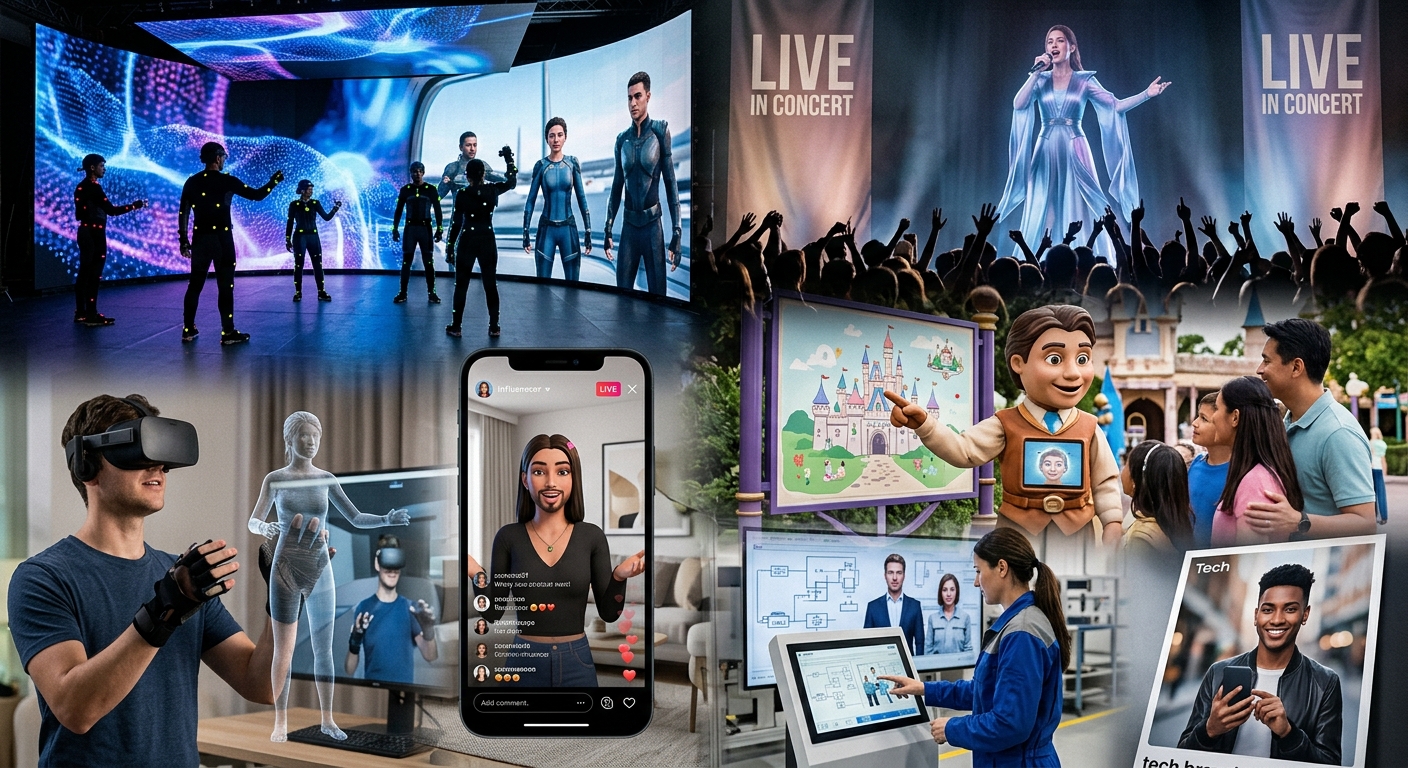
The Action section is where the guild turns from the conditions and contexts of synthetic performance to the performances themselves. Mouse examined how synactors are made — the tools, techniques, and technical substrates of synthetic character; Camera examined how their performances are staged, lit, and presented to an audience; Action asks what synactors actually do when they perform — what kinds of work they take on, where they do it, and what the specific demands of each performance context are.
Synactors perform across a remarkably wide range of contexts: in games, in film, on stage, in theme parks, in advertising, in training simulations, in social media, in virtual reality. Each context makes different demands and offers different possibilities. The skills required to deliver a coherent performance across twenty hours of branching game narrative are not the same skills required to hold a concert audience’s attention as a holographic performer, or to sustain a character through a feature film in which the synthetic figure shares the frame with live actors. The guild’s critical vocabulary must be adequate to all of these contexts, and this section attempts to build it.
What this section covers
The section opens with the two oldest and most developed performance contexts: games and film. Games are the primary medium of synthetic performance, and the guild’s argument — made in detail in the games article — is that the first genuine synactor performances occurred in Pac-Man in 1980, and that the medium has produced some of the most demanding and sophisticated synthetic acting in any form. Film offers a different set of challenges: the crowd performances made possible by systems such as Weta Digital’s Massive software, the performance-capture work of actors such as Andy Serkis and Roger Clark, and the contested territory of digital doubles, de-ageing, and the reconstruction of deceased performers.
Stage performance, other performance forms, and the specific question of stunt work each receive their own treatment. Stage offers unique challenges around liveness and audience proximity that film and games do not. Other forms — theme park performance, advertising, virtual reality, training simulation — are less critically examined than games and film but represent a significant and growing proportion of the work synactors actually do. Stunts raise the question of what physical extremity means for a performer who cannot be injured, and how the absence of genuine risk changes the audience’s relationship to the performance.
The boundary questions
Two of the section’s most important articles address territory that lies at the edges of straightforward performance criticism. The article on body and voice examines the problem of attribution in synthetic performance: when a human voice actor delivers an exceptional performance inside a synthetic character, how should credit be distributed between the voice performance, the body animation, and the production team that integrates them? This question is not merely administrative — it goes to the heart of what synthetic performance is and where its value resides. The guild’s awards categories have been designed with these distinctions in mind, and the article explains the reasoning behind them.
The article on humans playing synactors — the long tradition of human performers portraying robots, androids, and AI in science fiction — approaches synthetic performance from the outside. These performances are not descriptions of what synactors actually are; they are performances of what human audiences expect synactors to be. But studying them reveals the symbolic vocabulary through which audiences read synthetic behaviour, and that vocabulary is one every synactor needs to understand, whether to inhabit it or to refuse it. The article traces this tradition from Yul Brynner’s Gunslinger in the original Westworld (1973) through to the ensemble of HBO’s Westworld series (2016–2022).
Bloopers, uncredited performances, and the gallery
The section concludes with three articles that approach synthetic performance through failure, omission, and documentation respectively. The bloopers article treats performance failure — physics errors, AI misbehaviour, lip sync breakdown, the uncanny valley — as a productive critical category: understanding how performances fail is essential to understanding how they succeed. The article on uncredited performance addresses the systematic underrecognition of synthetic acting work in industry awards and critical discourse, and makes the case for why this matters. The gallery documents a selection of synthetic characters whose performances the guild considers significant, providing a reference point for discussions elsewhere in the site.
The section also carries the guild’s growing body of reviews: extended critical treatments of individual synthetic performances, written to the same standard as serious film or theatre criticism. The first reviews — of Clementine in Telltale’s The Walking Dead and of the anthology series Love, Death & Robots — are available from the sidebar. Further reviews will be added as the guild’s critical programme develops.