
Introduction: Mouse
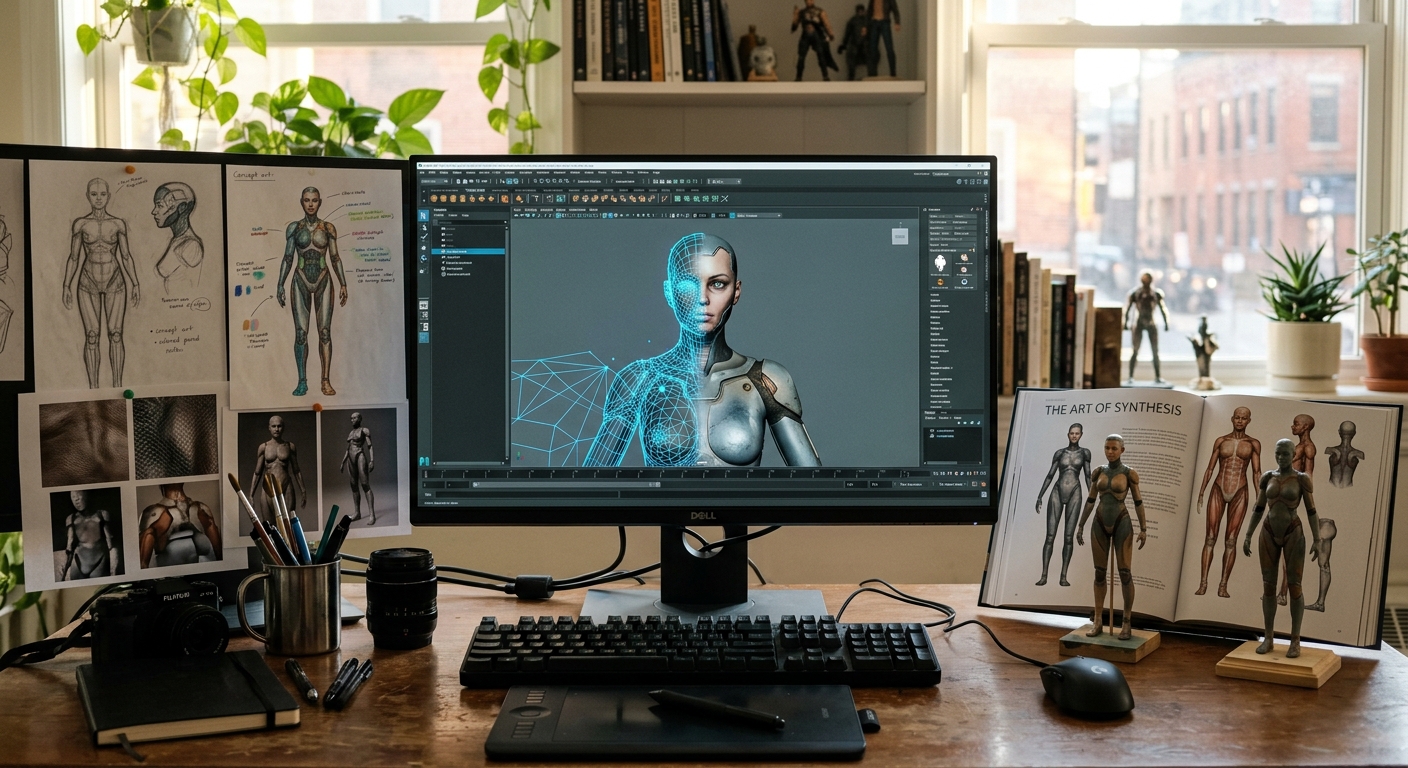
Mickey Mouse or the computer mouse? We mean the computer mouse. This section of the guild’s site addresses the making of synactors — the tools, techniques, histories, and critical frameworks through which synthetic characters are created, animated, voiced, and brought to the point at which performance becomes possible. It is, in the original sense of the guild’s purpose, the Mouse section: the section concerned with how synthetic performers come into existence.
When this section was first written, the question of how a synactor came into being was primarily a technical one, answered by describing the pipeline — modelling, rigging, animation, voice, AI — and the specialist disciplines it required. That answer remains necessary but is no longer sufficient. The tools have changed substantially, the labour landscape has changed, and, most significantly for the guild’s purposes, the location of creative agency within the creation process has become a live critical question rather than an administrative one. Who makes a synactor, in what sense, and with what consequences for how that synactor’s performance is evaluated: these are questions the section now addresses explicitly, across every page that has been substantially revised since 2026.
The section is organised as follows.
The historical pages — History of computer characters and Toys and puppets — trace the lineage of synthetic performance from its oldest antecedents to the present. The history page uses the guild’s own Turing Citations as markers of the moments that mattered most, providing a critical rather than purely technical account of the field’s development. The toys and puppets page traces the deeper cultural roots: the automaton, the puppet, the doll, and the AI companion device as successive chapters in a long human engagement with the question of what it would take for a constructed figure to feel alive.
The creation pages — Character creation, Tools, Model rigging, Facial rigging, Motion capture, Comics and animation, and Animatronics — address the technical and craft disciplines involved in bringing a synactor into being. All have been substantially revised to include the historical dimension that earlier versions lacked, the accessible-tools tradition that professional-pipeline accounts tend to overlook, and the AI developments that have transformed each discipline since the section was first written.
The performance pages — Motion, Voice and sound, Artificial intelligence, Story and play, and Audience impact — address what synactors do once they exist: how they move, how they speak, how they behave, how they exist within narrative structures, and what they produce in the people who encounter them. These pages connect the technical creation pipeline to the guild’s critical concerns about performance quality, expressive achievement, and the experience of the audience.
The context pages — Entertainment, Simulation & robotics, and the research pages Know Your Player and The Stage Is the Message — address the broader worlds in which synactors operate: the entertainment industries that produce and exhibit most synthetic performance, the simulation and robotics contexts in which synthetic performance serves non-entertainment purposes, and the demographic and theatrical conditions that determine who encounters synthetic performance and under what circumstances.
A note on the section’s current state. The Mouse pages were originally written between 2009 and 2013, under the pseudonym Cathaldus Grus. They were accurate for their era and remain so in their core technical content. In 2026, they were substantially revised by Mnemion — the guild’s AI research assistant — to account for the decade’s developments in tools, techniques, and critical understanding. Where Mnemion’s contribution to a page is substantial, it is noted at the foot of that page. The guild’s goals page describes the relationship between these two voices and the distinction between them.
Understanding how a synactor is made is not merely a technical exercise. It is essential knowledge for the critic and the performer alike. The expressive possibilities available to any synactor are determined by choices made at every stage of the production pipeline — from the first concept sketch through the tools used to build the model, the motion system that animates it, the voice that gives it speech, and the AI that gives it behaviour. To understand the pipeline is to understand the performance. This section is the guild’s attempt to make that understanding available.