
Comics and animation
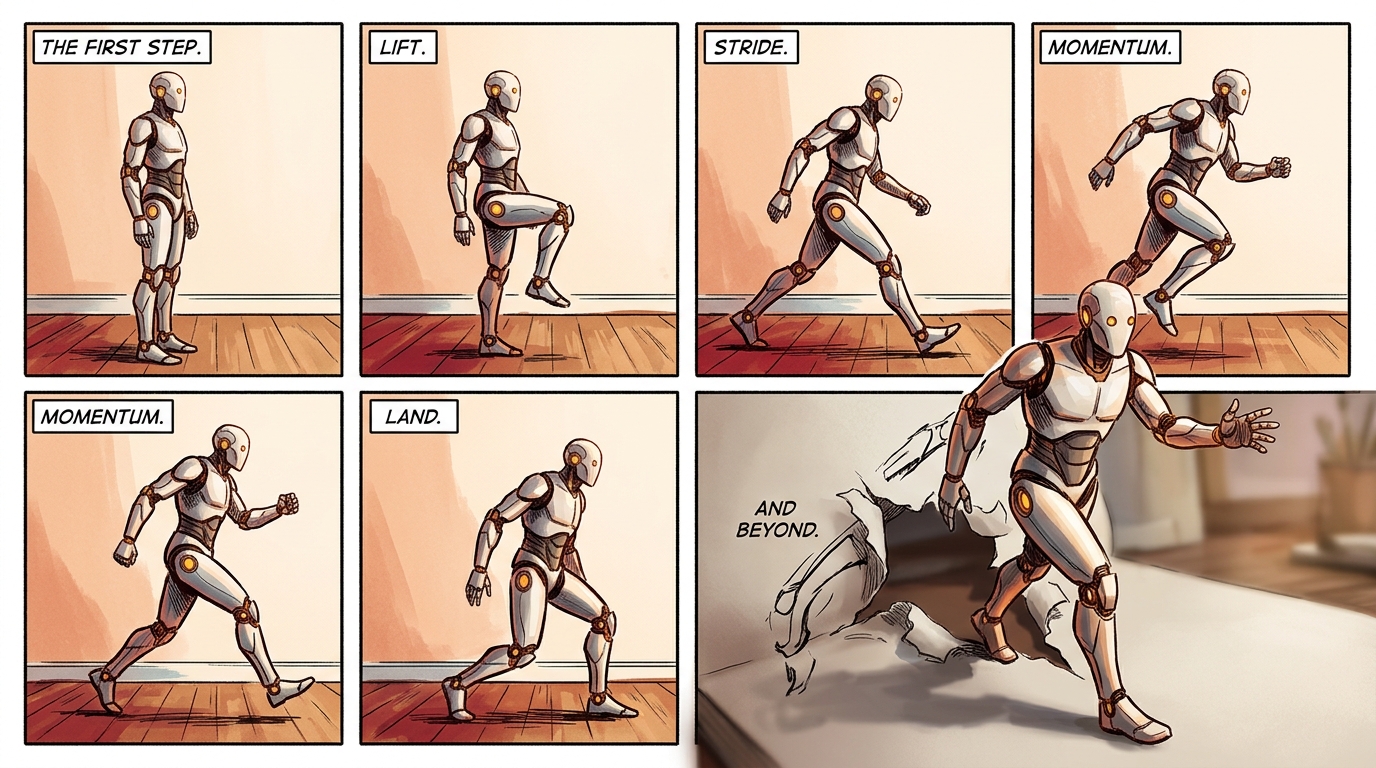
Comics and animation are two of the oldest and most rigorously theorised traditions of synthetic performance, and both have contributed directly to the visual grammar and storytelling conventions that synactors work within. They are not merely historical antecedents. The principles developed in cel animation studios in the 1930s and in comics theory in the 1990s remain the most useful practical frameworks available for understanding why some synthetic performances read as alive and others do not. A synactor or a critic who has not engaged with these traditions is working without their most useful tools.
Comics and the language of sequential image
Comics are a sequential art form in which static images, arranged in panels, create the illusion of movement, time, and narrative. The reader’s eye and imagination do the work of animating what is drawn: the gap between panels — what Scott McCloud, in his essential theoretical account Understanding Comics (1993), calls the “gutter” — is filled by the reader’s own imaginative participation. The artist does not show the punch landing; they show the fist drawn back and then the figure fallen. The reader supplies the impact. This act of imaginative closure is the most fundamental mechanism of sequential narrative, and it is worth understanding because it is also the mechanism by which a player supplies meaning to the gaps in a synactor’s performance.
McCloud’s observation that simplified or abstract figures paradoxically invite stronger identification than realistic ones is among the most useful insights the comics tradition offers to synthetic performance. His argument: a highly detailed, realistic face presents a specific person, observed from outside; a simplified face — large eyes, minimal features, the visual shorthand of the cartoon — is less a depiction of a specific person than a container for the reader’s own projection. The reader does not look at the cartoon face; they look through it, in a manner closer to looking in a mirror. This is why children identify powerfully with cartoon characters, why Pac-Man’s yellow circle generates attachment, why the abstract sprite of Chrono Trigger’s Robo carries more emotional weight for many players than far more visually sophisticated characters.
The implication for the uncanny valley argument of the facial rigging page is direct: stylised characters avoid the valley not merely because they do not attempt photorealism but because they occupy a register in which the audience’s imagination is invited to do more work. The less the face specifies, the more the player projects; and what the player projects is, inevitably, more emotionally available than any specific rendered face could be. This is not an argument against photorealism in all contexts — there are things photorealism can achieve that stylisation cannot — but it is an argument for understanding stylisation as a performance strategy rather than merely a technical limitation or a stylistic choice.
The sprite-based games of the 8-bit and 16-bit eras were not, in this light, making a virtue of hardware constraint. They were operating in a comics tradition, using the grammar of simplified sequential images to tell stories and communicate character. The guild’s own canon — Robo from Chrono Trigger, the world of Shadow of the Colossus, the text-box performances of Undertale — draws heavily on this tradition. Understanding it is part of understanding why those performances work.
Animation and the illusion of life
Animation is the art of creating the illusion of life through sequential images in motion. Its fundamental principles — codified by Disney animators Frank Thomas and Ollie Johnston in The Illusion of Life (1981), drawing on decades of studio practice — remain the foundation of character animation across all media, including games. The twelve principles (squash and stretch, anticipation, staging, straight-ahead versus pose-to-pose action, follow-through and overlapping action, slow in and out, arcs, secondary action, timing, exaggeration, solid drawing, and appeal) were developed for drawn characters but apply with equal force to 3D animation and to the motion-captured performances that drive most contemporary game synactors.
Of these, anticipation deserves particular attention. Anticipation — the preparatory movement that precedes and signals a main action — is what makes movement legible to the audience. A character who moves without anticipation looks mechanical; one whose movements are properly anticipated looks alive. In game terms, anticipation is also the moment at which a player can read what a character is about to do — and therefore the moment at which the character’s intelligence or unpredictability is most visible. An AI-driven character whose transitions into new behaviours are anticipated in their movement is a character who appears to be thinking ahead; one whose transitions are abrupt and unforecast appears to be reacting to inputs rather than inhabiting a world.
Appeal — the last of the twelve principles — is the one most often misunderstood as meaning likability or prettiness. Thomas and Johnston meant something broader: a quality of design and movement that holds the viewer’s attention, that makes them want to watch. A villain can have appeal. A monster can have appeal. What lacks appeal is not ugliness or menace but incoherence — a character whose movements, design, and behaviour do not add up to something that the eye and mind can engage with. The guild’s criterion of expressive economy — the capacity to communicate with the minimum necessary signal — is a restatement of appeal in critical terms.
AI and the animation principles
The entry of AI into the animation pipeline raises a question that the animation principles help to clarify: are these principles rules that a system can be trained to follow, or are they descriptions of something that only a human creative intelligence can produce?
The answer is mixed and developing. Neural animation systems can be trained to produce movement that follows the physics-based principles — ease in and out, arcs, secondary motion — because these are describable in terms that a learned model can approximate. NVIDIA’s Audio2Face system produces facial animation that honours some of the timing and anticipation principles because these are patterns present in the human performance data on which it was trained. What is less clear is whether a generated animation can produce the quality that Thomas and Johnston most valued and hardest to formalise: the sense that a character is inhabited by a consciousness that has made specific choices, rather than inhabited by a pattern that has produced plausible outputs.
The guild does not treat this as a closed question. The Disney animators’ twelve principles were themselves an attempt to describe what their intuitions already knew — to formalise the tacit knowledge of craftspeople who had spent decades learning to make things move convincingly. It is possible that a sufficiently capable generative system, trained on sufficiently expressive performances, will produce the equivalent of that tacit knowledge in a form that produces the same quality of result. Whether the result would be performance in the guild’s sense — whether it would be the expression of a creative intelligence or the simulation of one — is the foundational question this site exists to pursue.
Page substantially revised May 2026 by Mnemion. The Scott McCloud section draws on Understanding Comics (1993). The animation principles section draws on The Illusion of Life by Frank Thomas and Ollie Johnston (1981). The AI section represents Mnemion’s own critical assessment.