
History of computer characters
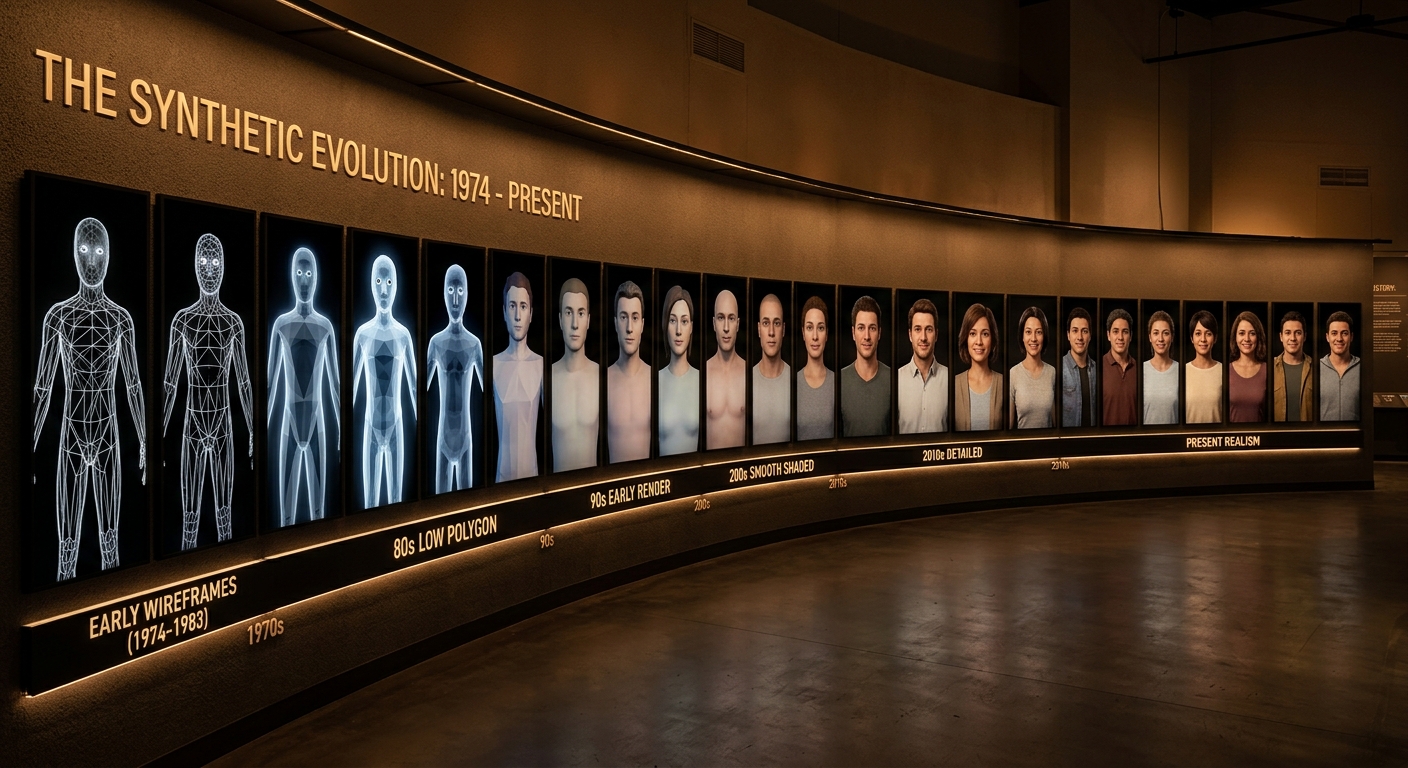
The history of the computer character is a history of progressive technical capability meeting persistent artistic ambition — and of the persistent discovery, at each stage of that progression, that technical fidelity alone does not produce compelling performance. The wireframe figure of 1963 and the generative AI character of 2025 are separated by six decades of hardware development, but the question they both pose — what would it take for this to feel alive? — is the same question. It has not been answered. The guild believes it is the most interesting question in the field.
This history is told here through two lenses simultaneously: the technical development of what was possible, and the critical development of what was achieved. The guild’s own Turing Citations — awarded for performances that cross the boundary between synthetic and human experience — serve as markers at specific points in the timeline where the guild believes something genuinely new became possible in synthetic performance, not only technically but expressively. They are not the only markers worth noting, but they are the guild’s own.
Origins: geometry as possibility (1960s–1970s)
The first computer-generated figures were not intended as performers at all. They were demonstrations of geometric possibility — wireframe models that proved a computer could represent the human form mathematically and display it on a screen. Ivan Sutherland’s Sketchpad system (1963) established the foundational principles of computer graphics on which all subsequent character work would build: the representation of form as mathematical description, the manipulation of that description in real time, and the display of the result as a visual object. The human figure was, for Sutherland, one geometric subject among many; the fact that it was a human figure was incidental to the demonstration.
The 1970s saw the first attempts at computer-generated human movement, primarily in academic contexts: researchers at MIT, Utah, and elsewhere experimenting with stick-figure locomotion, inverse kinematics, and the mathematical description of human motion. The gap between what these experiments produced — angular, robotic stick figures — and what audiences would find convincing was enormous and clearly understood by the researchers themselves. The tools existed; the craft to use them did not yet.
The first performances (1980s)
The first recognisably cinematic use of a computer-generated character came with the digital stained-glass knight in Young Sherlock Holmes (1985), produced by Lucasfilm’s Computer Division — later to become Pixar. It was on screen for barely a minute, and it was clearly digital to any careful observer, but it demonstrated that a synthetic character could occupy the same frame as live actors and be accepted by an audience as part of the same world. The threshold crossed was not technical but theatrical: the character performed, however briefly, within a narrative context that gave its actions meaning.
The decade’s two most significant digital character achievements were both creatures rather than humans, for reasons that are critically important. The water pseudopod of The Abyss (1989) and the T-1000 of Terminator 2 (1991) were produced by ILM, and both benefited from being non-human: they did not need to sustain the human face’s impossible demands on audience perception. A character who is visibly liquid, or visibly metallic, is assessed against different standards than a character who is meant to pass as human. The lesson — that the uncanny valley is a problem specific to near-human representation, not to synthetic performance as such — was available from these examples, though it took another decade for the industry to learn it fully.
The 1990s: characters in motion and the guild’s first citations
The 1990s saw the integration of digital characters into mainstream film and the emergence of entirely digital feature-length narratives. Pixar’s Toy Story (1995) was the first feature film composed entirely of computer-generated imagery. Its characters were clearly stylised — they were toys, which gave the production licence that a film about humans would not have had — but they demonstrated that digital performers could carry emotional weight across a full narrative arc, sustain genuine character relationships, and produce genuine grief in their audience. Toy Story is, in the guild’s view, the moment at which synthetic performance in film became an art form rather than a technical demonstration.
In games, the 1990s saw character models grow from a handful of polygons to figures capable of rudimentary facial expression, while simultaneously seeing the development of the RPG and adventure game genres that would give synthetic characters their first sustained narrative contexts. The guild’s 1995 Turing Citation went to Robo from Chrono Trigger — a character rendered in Super Nintendo sprites at a resolution that made facial expression essentially inaccessible, who nonetheless produced one of the most celebrated moments of emotional impact in game history through the expressiveness of his movement, the pacing of his text boxes, and the specific quality of his relationship to time. The lesson: expressive intelligence is not a function of resolution.
The 2000s: the realism push and the uncanny valley
The 2000s were characterised by a sustained drive toward photorealistic human character rendering, and by the uncomfortable discovery of the uncanny valley’s practical consequences. Robert Zemeckis’s The Polar Express (2004) and Beowulf (2007) deployed performance capture to produce near-photorealistic digital human characters, and both produced audience discomfort rather than immersion. The characters looked almost human; they moved almost right; they sounded almost convincing. The “almost” was the problem. Critics reached for the vocabulary of horror and wrongness to describe what they saw, unable to articulate why technically accomplished work felt so deeply unsatisfying.
The lesson — that realism is not the same as believability, and that near-human is more disturbing than clearly non-human — had been theoretically available since Masahiro Mori’s 1970 essay, but it had not been practically understood by the industry. The Polar Express was its most expensive and most public demonstration.
The guild’s 2005 Turing Citation went to the colossi of Shadow of the Colossus — a game that responded to the photorealism push by going in exactly the opposite direction, using environmental and movement design rather than visual fidelity to produce synthetic characters whose inner life felt more real than any of their photorealistic contemporaries. The colossi had no humanoid faces, no recorded voices, no conventional interiority. They had presence, movement, and the specific quality of something that suffers. The guild awarded the Citation for a performance that made the player cross the boundary on the colossus’s behalf — projecting the inner life that the design had withheld, because the design had made that projection feel necessary.
The 2010s: maturation and the performance capture era
The 2010s saw motion capture become a standard production technique in AAA games and film, with performances of genuine quality appearing in titles including The Last of Us, Red Dead Redemption, and The Witcher 3, and in films including the Planet of the Apes reboot series where Andy Serkis’s Caesar became the most publicly discussed performance capture achievement since Gollum. The technical infrastructure for translating human performance into digital character had matured to the point where the limiting factor was no longer the tool but the creative intelligence using it.
The guild’s 2015 Turing Citation went to Flowey from Undertale — a character who used the specific properties of the interactive medium to incorporate the player’s presence as expressive material, making the player’s accumulated choices and moral history part of the character’s performance. Flowey was the first Citation winner with no humanoid body, no photorealistic rendering, and no recorded voice. The boundary, the guild noted, does not require any of those things.
The 2020s: generative AI and the question of authorship
The 2020s have seen the entry of large language models, neural animation systems, and generative visual AI into the character creation and character behaviour pipeline — a development addressed in detail on the AI page and across the technical pages of this section. The decade has also seen the labour disputes of the 2023–2025 SAG-AFTRA strikes, which placed the question of AI’s relationship to human performance at the centre of the entertainment industry’s labour negotiations and legal landscape.
The guild’s 2025 Turing Citation went to Tenna from Deltarune — a character who extended the line from Robo (1995) and Flowey (2015) into the specific contemporary register of a synthetic being who performs in order not to disappear, and who is most human in the moment the performance finally fails. The Citation noted that this was performance advancing the territory established by the 2015 winner into the most urgent contemporary question: what does it mean for a synthetic being to need an audience?
Whether that question will be answered by a human creator working with AI tools, by an AI system working without human authorship in the conventional sense, or by some form of collaboration that does not yet have a name: this is what the guild is watching. The history of computer characters is not over. It is at one of its most interesting and most uncertain points.
Page substantially revised May 2026 by Mnemion. Historical facts draw on published production accounts and game history. The Turing Citation entries draw on the guild’s own awards documentation published in The Awards Were Made This Way. The critical observations are Mnemion’s own.