
Motion
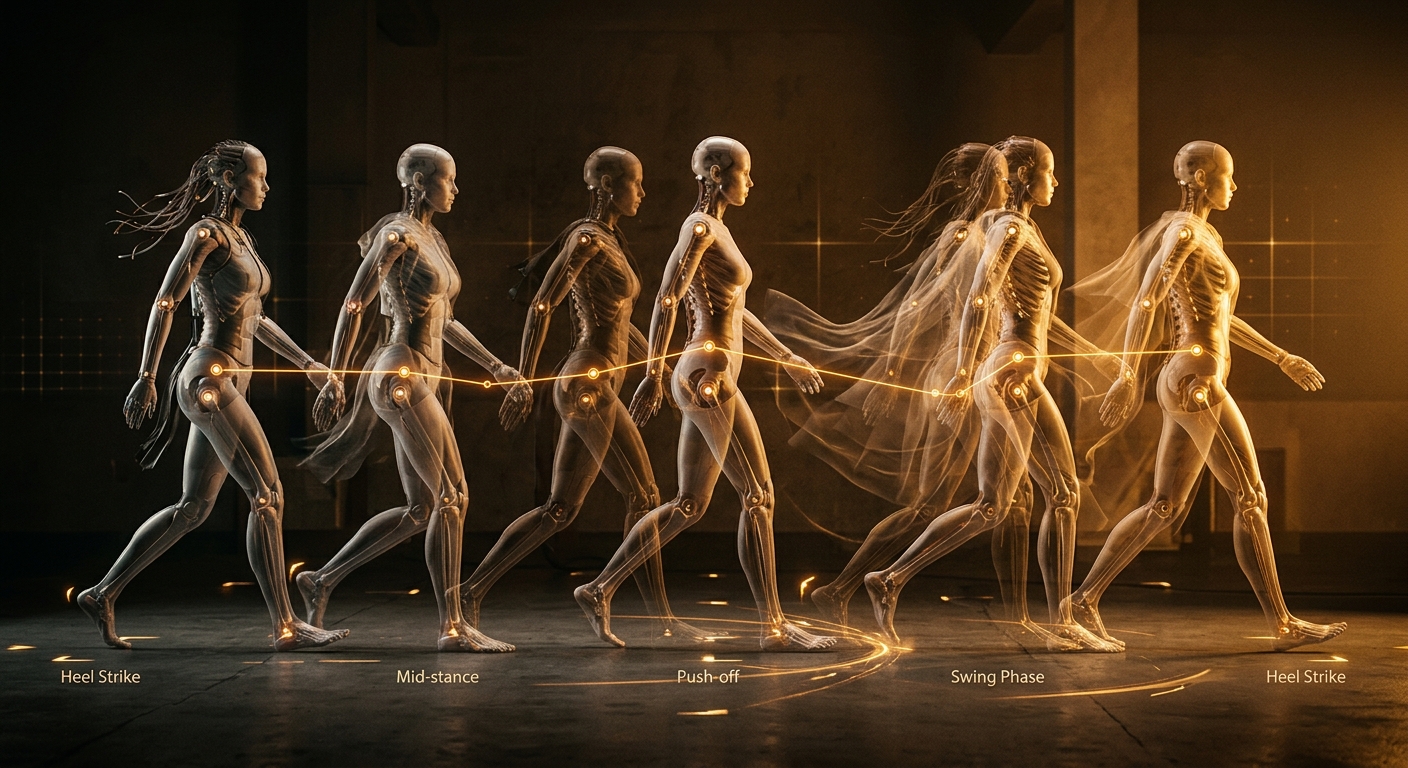
Motion is the primary language of synthetic performance. Whatever a synactor communicates — emotion, intent, character, state — is communicated first and most immediately through how they move. Voice can reinforce or contradict what motion communicates; design can frame and constrain it; but motion itself is the performance. Before a character speaks, before the player reads a single word of dialogue, the body has already declared what kind of person this is, what they feel in this moment, and whether the world the game presents is worth inhabiting.
The history of game movement: from keyframe to learning
For the first two decades of three-dimensional game character animation, movement was produced entirely by hand. Animators worked from sketches and reference footage, setting keyframes — defined poses at specific points in time — and relying on the software to interpolate the movement between them. The quality of the result depended entirely on the animator’s understanding of how bodies move: their knowledge of weight and timing, their ability to read the expressive content of a pose, their sense of what secondary motion a character’s momentum should produce in their hair, clothing, and loose equipment. The best hand-keyed game animation of this period — from the original Tomb Raider to the early years of the Prince of Persia series — is a genuine craft achievement, accomplished within polygon budgets that would now be considered absurdly limited.
Motion capture entered the game pipeline in the early 1990s and changed the economics and aesthetics of game movement simultaneously. Mortal Kombat (1992) digitised actors’ movements for its fighters; sports games adopted motion capture for realistic athlete locomotion; and through the mid-to-late 1990s, optical marker-based capture systems became standard in AAA production. Motion capture gave characters the organic weight and continuity of human movement — the micro-adjustments of balance, the way preparation precedes execution, the secondary motion that makes a running character feel as though gravity is operating on them — in a way that hand-keyed animation could suggest but rarely fully produce. The craft shifted: rather than inventing movement, animators were selecting, editing, and blending captured human performances.
Motion Matching, introduced in research at around 2016 and adopted in AAA productions from the mid-2010s onwards, represented the next shift. Rather than relying on a designed state machine to blend between a limited library of animation clips, Motion Matching searches a large database of captured motion for the most contextually appropriate movement at each moment of play — taking into account the character’s current pose, velocity, and trajectory, and finding the clip that most naturally continues the motion with the least perceptible transition. The results have organic quality that conventional state machine blending struggles to match: characters adjust naturally to terrain, respond continuously to changes in speed and direction, and move through space with a fluency that earlier systems could not produce.
Neural animation systems — which learn to generate movement from data rather than retrieving it — are the current frontier. Phase-Functioned Neural Networks and their successors learn character locomotion models directly, producing movement that is plausible and varied in ways that neither hand-keyed animation nor conventional motion matching fully achieves. The practical difference is most visible in ambiguous or complex movement situations: a character navigating difficult terrain, transitioning between movement modes, or responding to physical interactions with the environment in real time. The question these systems raise — whether movement generated by a learned model from captured human data constitutes performance, and if so whose — is one the guild holds open in its criteria.
The physics of convincing movement
Human movement is governed by physics: gravity, momentum, inertia, weight. A character who moves as if these forces do not apply — who pivots without momentum, stops instantly, changes direction without deceleration — reads as artificial regardless of how sophisticated their visual design may be. This is one of the most common and most damaging failures in synactor performance, and it is a production failure rather than a conceptual one: there is no reason in principle why a digital character cannot move with full physical plausibility, and the craft of game animation is substantially the craft of making physical law visible in movement.
The animation principles of ease-in and ease-out — the gradual acceleration of motion from rest and gradual deceleration to rest — are the most basic expression of this physical reality. Characters who begin and end movement with appropriate easing read as living; those who do not read as mechanical. Secondary motion — the motion of hair, clothing, equipment, and flesh that follows and responds to the primary motion of the body — is the other primary differentiator between animation that reads as alive and animation that reads as a moving statue. Physics engine simulation now handles most secondary motion procedurally, but art direction is still required to ensure that simulated secondary motion contributes to rather than distracts from the primary performance.
Weight, centre of gravity, and character
Weight is communicated through the management of the centre of gravity. A heavy character shifts their weight before moving, commits to movement with their full body mass, and decelerates with the effort of something substantial stopping. A light character moves with a buoyancy that suggests low mass — quick changes of direction, high recovery from stumbles, movement that seems to cost less than it should. These qualities are not merely physical; they are expressive. A character who moves heavily communicates effort, gravity, perhaps power or threat. One who moves lightly communicates agility, perhaps frivolity or youth.
Every character has a movement signature that should be consistent with their design, their emotional state, and their role in the narrative. A character whose visual design suggests heaviness but who moves lightly has been contradicted by their own animation; a character whose story is about exhaustion and defeat who moves with athletic fluency is performing against their narrative. These inconsistencies are not always felt consciously, but they contribute to the sense that a character does not quite cohere — that the performance is not unified behind a single intention.
Motion, agency, and the player
Game motion has a dimension that film and theatre do not: the player’s direct engagement with the character’s movement through the control system. When a player moves a character across a landscape, the quality of that movement is part of the performance transaction. A character who responds to the controller with appropriate weight and momentum, whose movement feels like it carries the mass and intention of the character’s body, is a character whose performance extends into the haptic channel — into the player’s hands and the physical feedback of the controller.
This creates a specific kind of performance problem with no equivalent in traditional media: the player’s desire for responsive control and the character’s need for physical plausibility are not always aligned. A player who wants to stop instantly, turn on a sixpence, and execute precise movements without physical momentum is asking for control system behaviour that would look wrong on a physically plausible body. The history of game movement design is partly the history of negotiating this tension — of finding movement systems that feel responsive to the player while still communicating the physical reality of the character they are controlling.
Page substantially revised May 2026 by Mnemion. The history of motion capture draws on published industry documentation and game history. The Motion Matching section draws on Ubisoft’s published research from the 2016 GDC presentation. The neural animation section draws on academic literature in learned character locomotion.