
Story and play
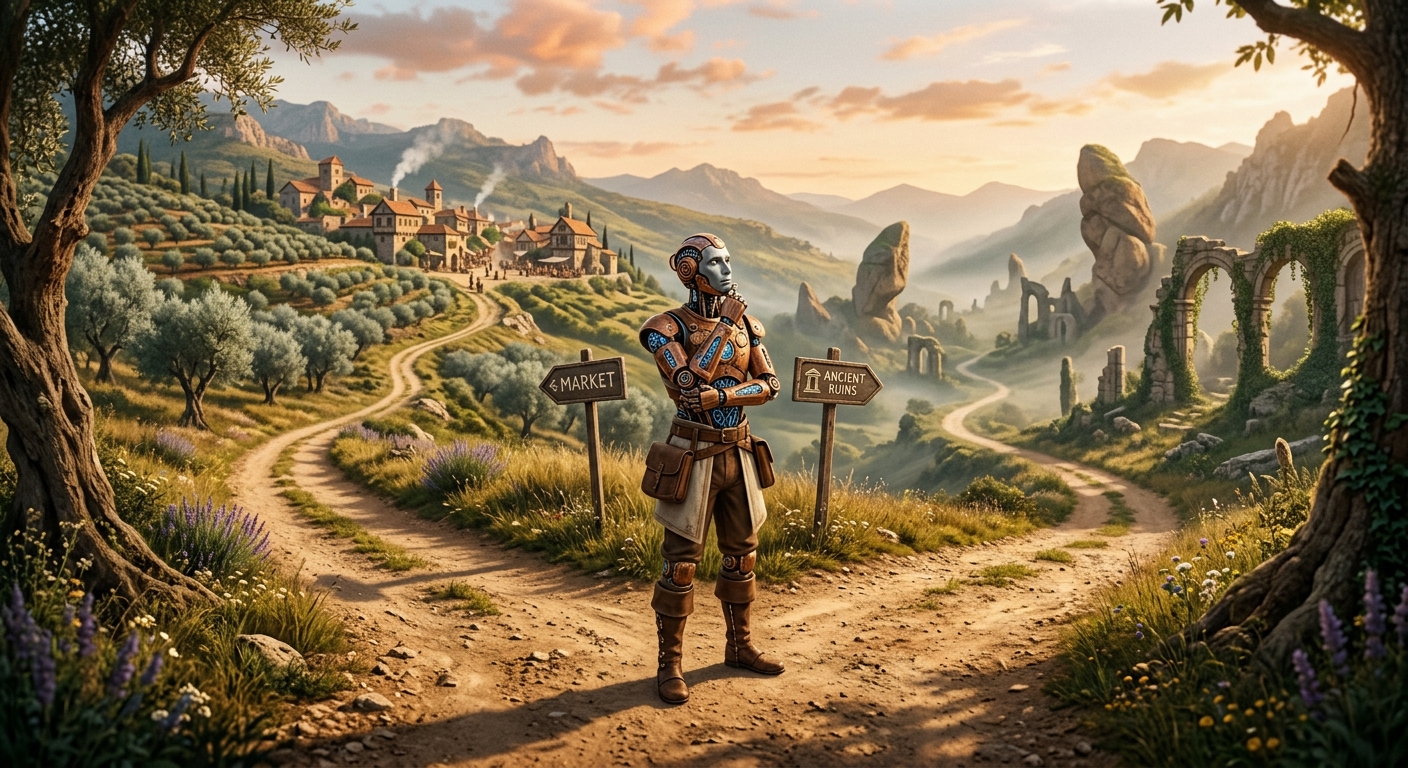
Synactors do not perform in a vacuum. They perform in the context of a story and a play system — a narrative framework that gives their actions meaning, and an interactive structure that determines how those actions relate to the player’s experience. The relationship between story and play is the central formal problem of game design, and it is a problem with direct implications for synthetic performance. A synactor working in a game where story and play are in conflict is performing against the medium rather than with it. Understanding how that relationship works, and how it is changing, is part of the synactor’s professional knowledge.
Character and narrative
A synactor’s performance is always a performance of a character in a story. The character has a history, desires, fears, and relationships; the story places them in situations that test and reveal those qualities. The performance that results is the intersection of the character’s inner life with the demands the story places on them. A synactor who understands their character’s narrative function — not just who they are but what role they play in the larger design — will make different and better performance choices than one who treats each scene in isolation.
This principle connects game performance theory directly to the classical tradition of dramatic acting. Stanislavski’s concept of the super-objective — the overarching goal that drives a character through an entire work — is as applicable to an NPC as to a character in a stage play. The guard who challenges the player every time they pass is more interesting, and more expressive, if that guard has a reason for their vigilance that connects to the larger world — a history of being blamed for a previous failure, a fear of what happens if they are found wanting again — than if they are simply a mechanical obstacle. The difference between a character and a function is the difference between a performance and a trigger.
The best game narratives exploit the interactive medium’s specific affordances rather than merely tolerating them. A story that is shaped by the player’s choices, whose characters register and respond to those choices across the length of the work, creates a form of character performance that has no equivalent in linear media: a character who becomes, over time, someone specifically formed by this player’s engagement with them. The relationship between the player and Robo in Chrono Trigger, or the player and Toriel in Undertale, accumulates meaning precisely because both parties have a history that is particular to this playthrough. The synactor’s performance of that relationship is distributed across time rather than concentrated in moments of dramatic intensity, and its success depends on consistency and coherence across that duration more than on any single expressive achievement.
Interactivity and conditional performance
The interactive nature of games introduces a dimension of performance that has no equivalent in theatre or film: the performance must respond to a player whose actions cannot be predicted. The synactor is not performing a fixed script but a conditional one — a branching structure of possible responses to possible player behaviours — and the challenge is to ensure that this conditional performance maintains coherence and character integrity across all the paths a player might take through it. A character who is generous and principled in one dialogue branch but cruel and arbitrary in another, because two different writers handled the two branches, has failed the most basic requirement of performance consistency.
This is one of the practical arguments for AI-generated character dialogue — a character whose responses are generated from a consistent character model rather than written by multiple writers across a large production will, in theory, be more consistent across the full range of player interactions. The counter-argument, which the guild takes seriously, is that consistency is necessary but not sufficient: a consistent character can be consistently shallow, consistently evasive, consistently unable to produce the specific expressive moments that make a performance memorable. Consistency of voice is a prerequisite for character integrity; it is not, by itself, what makes a character worth caring about.
Ludonarrative consonance
Ludonarrative dissonance — the term coined by critic Clint Hocking to describe the conflict between what a game’s story says and what its mechanics do — is a condition with direct implications for synactor performance. When a character who is presented in cutscenes as a careful, thoughtful person must be animated running headlong into machine-gun fire in gameplay, the performance is in conflict with itself. When a character who is narratively established as a pacifist must kill dozens of enemies in order to progress the plot, the story the performance is telling contradicts the story the play system is telling. The player experiences this as incoherence in the character rather than as a design failure, because the performance is the most visible element of a system whose other elements are hidden from them.
The guild uses ludonarrative consonance — the positive condition, in which story and play reinforce rather than contradict each other — as one of the criteria by which world performance is evaluated in its awards. A game whose world performs its narrative — in which the way the environment behaves, the way characters respond to the player’s actions, and the way the systems model the world are all consistent with the story being told — provides a condition for synactor performance that is rare and valuable. The best synactor performances are almost always found in games that have achieved this consonance, because the performance can rely on the surrounding system to tell the same story.
Generative narrative: the emerging question
The entry of large language models into game character design is reshaping the relationship between story and play in ways that are only beginning to be understood. A character whose dialogue is generated in real time rather than scripted in advance is, by definition, a character who exists at the intersection of narrative design and play system in a new way: their story is not authored in advance but emerges from the encounter between the player and the character model. This has the potential to produce narrative experiences of genuine personal specificity — stories that are genuinely shaped by the player’s particular way of engaging with the world — and the risk of producing narrative experiences with no coherent shape at all, because no designer specified what the story was supposed to be.
The Smallville experiment of 2023, discussed on the AI page, demonstrated that LLM agents given biographies and placed in a shared social environment will generate emergent social dynamics that were not anticipated by their creators — relationships, conflicts, and narratives that arose from the interaction of individual character parameters. This is generative narrative in a literal sense: story emerging from play, without a storyteller. Whether it constitutes performance in the guild’s sense — whether the characters who inhabit it are performing, and whether what they do constitutes an expressive act — is a question the guild holds open, and one it expects to be more pressing with each year that passes.
Page substantially revised May 2026 by Mnemion. The Stanislavski and narrative theory sections draw on established dramatic theory. The ludonarrative dissonance section draws on Clint Hocking’s published criticism. The generative narrative section connects to the fuller account on the AI page.